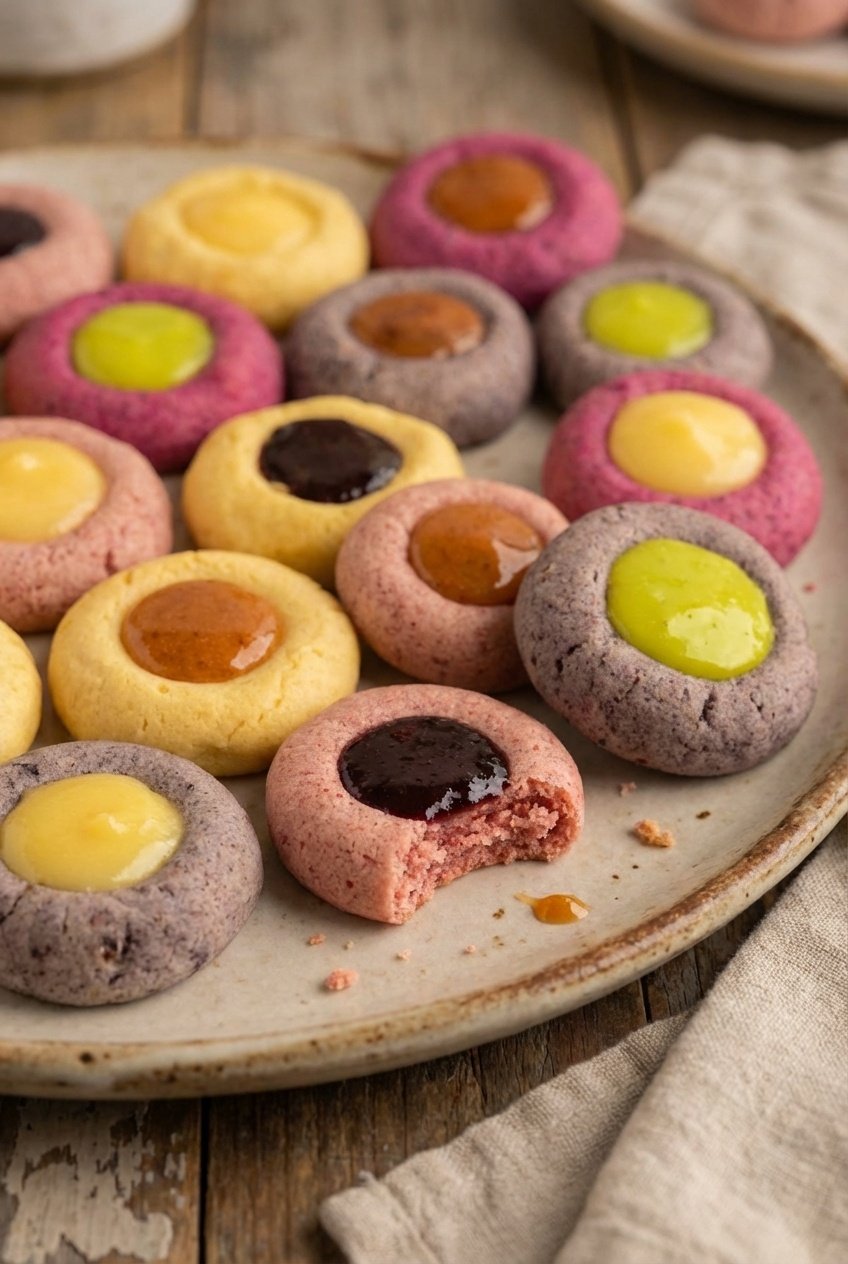
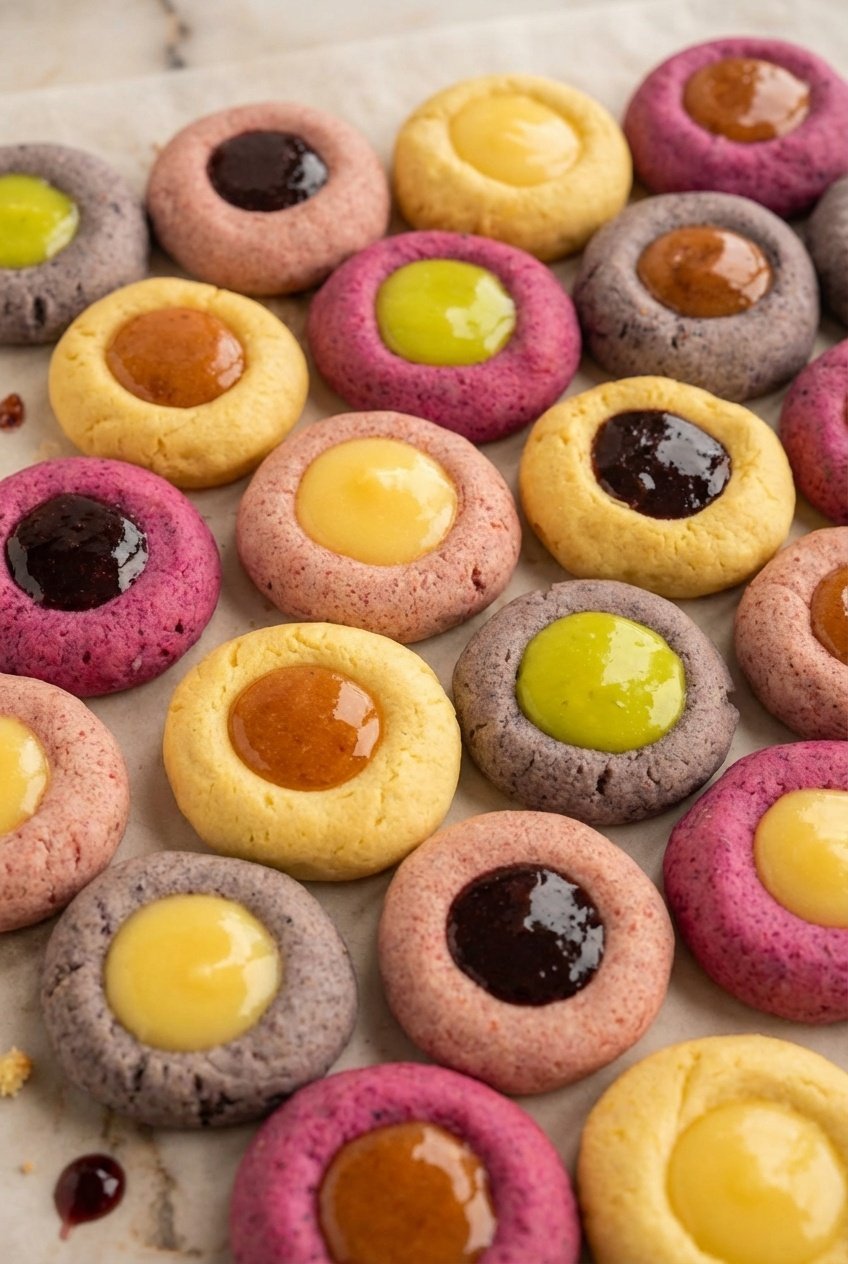
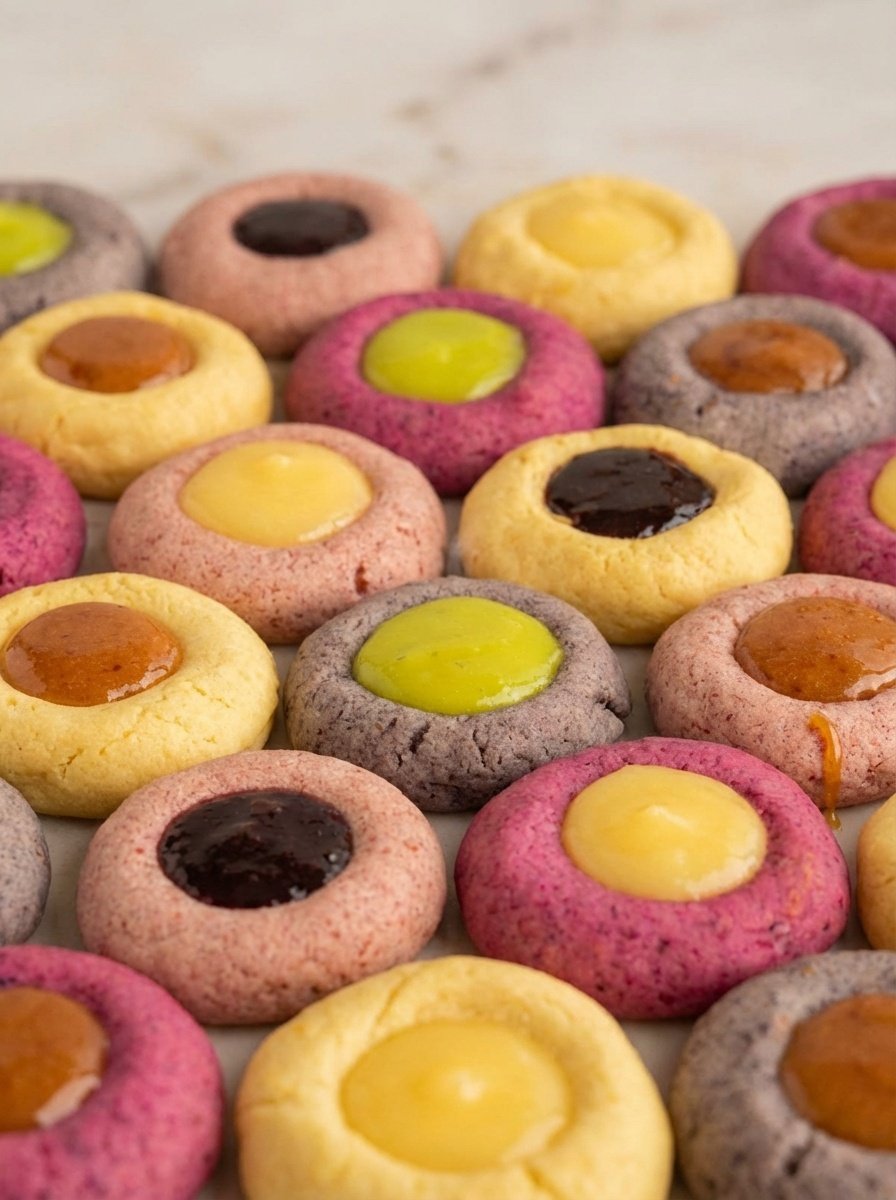
This 45-minute Fruit Filled Cookies recipe uses 7 basic dough ingredients alongside your favorite jam or homemade citrus curd, resulting in a beautifully vibrant, melt-in-your-mouth sweet treat. When warmer weather arrives, I want desserts that reflect the changing of the seasons: bright, refreshing, and endlessly customizable. These gorgeous pastel cookies swap traditional heavy flavor profiles for a tender, buttery base infused with actual freeze-dried fruit powder, making them the absolute quintessential spring cookies.
When I first tested this dough, the cookies spread too much in the oven, and the center well—the most important part of a thumbprint cookie—vanished completely into a flat pancake. So, I reduced the butter slightly and enforced a strict chilling time of 30 minutes. It was an absolute game-changer. The cookies baked up round and puffy, cradling their vibrant fruity centers perfectly. Every bite should snap gently at the edges before melting onto your palate with a massive burst of bright, tangy flavor.
Whether you fill these beautiful fruit cookies with store-bought jam, fresh fruit compotes, or my incredibly zesty homemade lime curd, you are going to fall in love.
What is this recipe?
Fruit Filled Cookies (often called thumbprint cookies) are a classic bakery staple reimagined for the modern home cook. At their core, these are delicate, shortbread-like cookies where the dough is scooped into a ball, indented in the center, and filled with a sweet or tart filling before or after baking.
What sets this specific recipe apart is the revolutionary addition of freeze-dried fruit right into the dough itself. Instead of relying solely on the center filling for flavor, we process freeze-dried strawberries, raspberries, or mangoes into a fine, concentrated powder. When you fold this brightly colored fruit dust into your butter and sugar base, it naturally dyes the dough a gorgeous pastel shade without a single drop of artificial food coloring. It also infuses the cookie base with an intense, authentic fruit flavor that won't compromise the structure of the dough.
The result is a two-toned, double-fruit experience. You get a tender, fruity cookie base complemented by a gooey, rich center made of jam or homemade curd. They are the ultimate sweet snacks for afternoon tea, springtime picnics, or bridal showers. Because they look incredibly elegant but require very little hands-on effort, they have quickly become my go-to contribution for any warm-weather gathering.
5 pro Tips for Making this recipe
To ensure your Fruit Filled Cookies turn out like they came straight from a boutique bakery window, follow these essential professional tips.
1. Do Not Skip the Chill Time
If I could scream this from the rooftops, I would: chill your dough! This is not merely a suggestion; it is a structural necessity. Because this dough relies on butter for its melt-in-your-mouth texture, baking the cookies at room temperature will cause that butter to melt rapidly before the flour has a chance to set. You want round, puffy cookies that can hold a generous dollop of filling in the center. Chill the prepared dough balls on their baking sheet for at least 30 minutes in the fridge, or overnight if you have the patience.
2. Grind the Fruit Completely Fine
The freeze-dried fruit must be blitzed into a very fine, powdery consistency before being added to your dry ingredients. If you leave large, chunky pieces of dried fruit in the mix, they will absorb moisture irregularly from the butter and eggs, leading to a lumpy dough that cracks wildly when you press your thumb into it. Use a powerful food processor, a high-speed blender, or a traditional mortar and pestle to grind the fruit down until it resembles fine sand.
3. Utilize Mise En Place
Mise en place is a French culinary phrase meaning "putting in place." Make sure you have all of your ingredients measured, prepped, and ready to go before you begin creaming the butter and sugar. Once you start mixing the dough, you don't want to stop to hunt for vanilla extract or pause to grind your fruit. Having everything organized will save you time, keep your workspace clean, and prevent accidental omissions.
4. Create the Perfect Indentation
While the classic method is using your literal thumb to make the center well (hence "thumbprint"), I often find that my thumbs create uneven, sometimes deep-cracking indentations. For a flawlessly smooth and professional-looking crater, use the rounded back of a measuring spoon (like a half-teaspoon or a melon baller). Press down gently but firmly while the dough ball is still room temperature, before chilling. If the edges crack slightly, just pinch them back together with your fingers to seal them.
5. Perfecting the Curd Consistency
If you decide to make the homemade citrus curd for the center, pay close attention to the cooking process. Whisk constantly over low-medium heat. When I first tested the lime curd, I was impatient and turned the heat to high—resulting in scrambled eggs and a metallic taste. Patience is key. It should take about 5-10 minutes. The curd is ready when it turns wonderfully glossy, thickens visibly, and coats the back of a spoon with a silky, sunshine-yellow (or pale green) blanket. It will continue to thicken significantly as it chills in the fridge.
Ingredients Needed
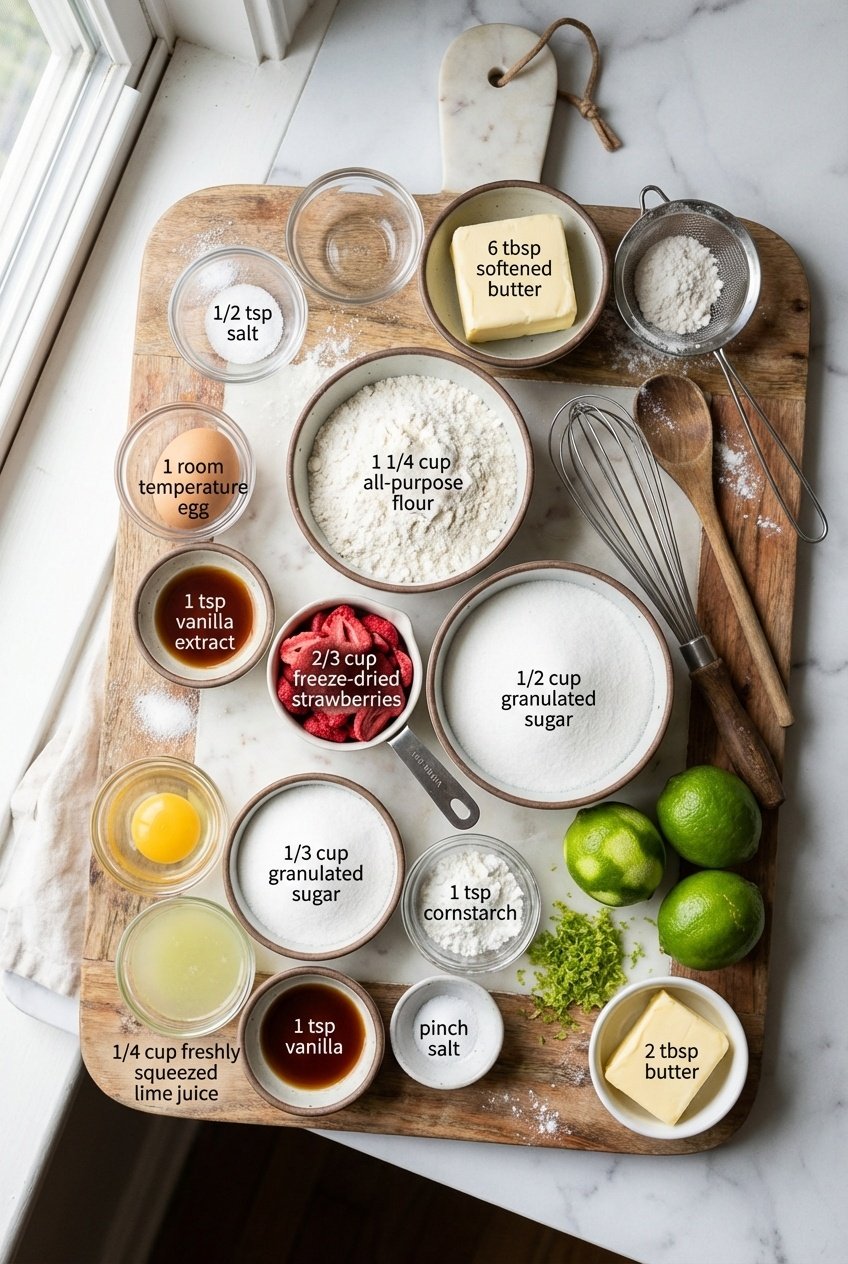
Creating these fruit cookies requires an array of standard baking staples, plus a few specialty items that give them their distinctive flair.
For the Cookie Dough
- Butter (6 tablespoons): Use unsalted butter, softened to room temperature. It should yield slightly when pressed but not look greasy or melted. Butter provides the structure and rich flavor for these cookies.
- Granulated Sugar (½ cup): Essential for sweetening the dough and creating crisp edges. Granulated sugar aerates the butter when creamed together, ensuring a tender crumb.
- Egg (1 large): The egg acts as our primary binder, holding the flour and butter together. Make sure your egg is at room temperature so it emulsifies perfectly with the creamed butter.
- Vanilla Extract (1 teaspoon): Pure vanilla extract enhances the fruity flavors, giving the cookies a rounded, warm undertone.
- All-Purpose Flour (1 ¼ cups): Spoon and level your flour carefully. Too much flour will result in a dry, crumbly dough that cracks heavily when indented.
- Salt (½ teaspoon): Crucial for balancing the sweetness. If you only have salted butter on hand, reduce this added salt to ¼ teaspoon.
- Freeze-Dried Fruit (⅔ cup): This is the magic ingredient! You can use freeze-dried strawberries, raspberries, mangoes, or blueberries. Do not use standard chewy dried fruit (like raisins or dried cranberries) or fresh fruit; it must be the crisp, freeze-dried variety to process into a powder properly.
For the Optional Homemade Lime or Lemon Curd
- Egg (1 large): Provides the luxurious, creamy structure and rich mouthfeel characteristic of good curds.
- Granulated Sugar (⅓ cup): Balances the sharp acidity of the citrus juice.
- Cornstarch (1 teaspoon): Acts as an insurance policy! It helps thicken the curd and gently protects the egg proteins from scrambling too quickly.
- Lemon or Lime Juice (¼ cup): Use freshly squeezed juice for the best, brightest flavor. Bottled juice often contains preservatives that mute the vibrance of the fruit.
- Vanilla Extract (1 teaspoon): Adds a whisper of bakery-style warmth.
- Salt (1 pinch): Just a tiny dash to elevate the citrus notes.
- Citrus Zest (Zest of 4 limes, or 2 lemons): This is where the essential oils live. It should smell wildly aromatic and brightly acidic when you grate it. Only grate the colored part of the skin; the white pith underneath is bitter.
- Butter (2 tablespoons): Whisked in to provide a glossy sheen and a velvety finish.
- Green Food Coloring (Optional): If making lime curd, you can add one tiny drop to give it a pop of spring green color, as natural lime curd usually looks somewhat pale yellow.
For Easy Alternatives
- Store-Bought Jam: If you don't want to make curd, substitute with any high-quality store-bought preserves. Raspberry, apricot, strawberry, or blackberry jam work beautifully.
Step-by-Step Instructions
Baking is a science, and following the steps in the correct order is vital for ensuring your Fruit Filled Cookies are perfectly tender and holds their shape.
Step 1: Prepare the Homemade Curd (If using)
If you are making the homemade citrus curd, start this first, as it needs ample time to chill and set. In a small bowl, thoroughly whisk together the egg, sugar, cornstarch, salt, and citrus zest. Whisk aggressively until the mixture is pale and completely combined. Slowly whisk in the fresh citrus juice and vanilla extract.
In a small, heavy-bottomed saucepan, melt the 2 tablespoons of butter over low-medium heat. Once melted, pour your egg and juice mixture into the saucepan. Here is where you must be vigilant: whisk continuously over medium-low heat for about 5 to 10 minutes. Do not walk away! You will feel the mixture start to drag against the bottom of the pan as it thickens and begins bubbling gently. Once the curd can coat the back of a spoon and leaves a clear line when you swipe your finger through it, immediately remove it from the heat.
Optional: Stir in one drop of green food coloring if you are making lime curd.
Strain the hot curd through a fine mesh sieve into a clean glass jar. This removes the zest and any tiny bits of cooked egg, ensuring a totally silky smooth texture. Press a piece of plastic wrap directly onto the surface of the curd to prevent a skin from forming, and chill in the refrigerator for at least 2 hours.
Step 2: Prepare the Fruit Powder
Place your freeze-dried fruit into a blender or food processor. Pulse the fruit until it breaks down into a very fine, vibrant powder. If there are any stubborn chunks remaining, you can crush them using a mortar and pestle or by placing them in a zip-top bag and rolling over them heavily with a rolling pin.
Step 3: Mix the Dry Ingredients
In a medium bowl, whisk together the measured all-purpose flour, the salt, and your freshly ground fruit powder. The powder will tint the flour a lovely pastel hue. Set this aside.
Step 4: Cream the Butter and Sugar
In the bowl of a stand mixer fitted with the paddle attachment (or using a large bowl with an electric hand mixer), beat the softened butter and granulated sugar together on medium-high speed. Beat them until they are remarkably pale and fluffy, which should take about 2 to 3 minutes. Scrape down the sides of the bowl with a rubber spatula.
Step 5: Incorporate Wet Ingredients
Add the room temperature egg and the vanilla extract to the creamed butter mixture. Beat on medium speed until the wet ingredients are completely incorporated. It should look smooth and creamy.
Step 6: Combine Wet and Dry
Pour your dry flour-fruit mixture into the wet ingredients. Turn your mixer to the lowest possible speed. Mix just until a cohesive dough forms and no streaks of dry flour remain. Do not overmix! Overmixing develops the gluten in the flour and will result in tough cookies. The dough should feel soft, pliable, and smell intoxicatingly fruity.
Step 7: Shape and Indent
Line a large baking sheet with high-quality parchment paper or a silicone baking mat. Using a standard cookie scoop (about 1.5 tablespoons), portion out the dough. Roll each portion firmly between your palms until it is a perfectly smooth ball. Arrange the 12 dough balls evenly on the prepared baking sheet.
Now, use your thumb, knuckle, or the rounded back of a measuring spoon to gently press into the top center of each dough ball. Push down far enough to make a deep crater, but not so far that you break through the bottom of the cookie. If the edges crack significantly, gently mold them back together with your warm fingertips.
Step 8: Chill the Dough
Transfer the entire baking sheet of formed, indented cookies into the refrigerator. Chill them uncovered for a minimum of 30 minutes, or wrap the pan in plastic wrap and chill overnight.
Step 9: Bake
When you are ready to bake, preheat your oven to 350ºF (175ºC). Place the chilled baking sheet on the middle rack of the oven. Bake for exactly 11 to 13 minutes. Because of the fruit powder, these cookies won't brown significantly on top, but the edges will look set and very lightly golden at the bottom.
Step 10: Reinforce and Fill
Immediately upon removing them from the oven, you may notice that the center indentations puffed up during baking. While the cookies are still piping hot, gently use your spoon to press down the centers once more, reinforcing the well.
Allow the cookies to cool completely on the baking sheet. Once cooled to room temperature, spoon a generous dollop of your chilled homemade curd or your favorite store-bought jam into the center well of each cookie. Serve and enjoy your gorgeous, bakery-style Fruit Filled Cookies!
Reheating Tips
While Fruit Filled Cookies are technically a dessert that is intended to be eaten at room temperature or even slightly chilled (especially if using a homemade curd), sometimes there is nothing quite like the experience of a warm, fresh-from-the-oven cookie.
If you want to mimic that fresh-baked warmth and smell, you have a few options. I do not recommend microwaving them, as the butter in the shortbread-like dough will melt too rapidly, rendering the cookie greasy, and the jam will become dangerously hot and liquid-like.
Instead, if you have filled the cookies with jam (do not do this with the egg-based curd), you can place them in a toaster oven or regular oven set to 300°F (150°C) for about 3 to 4 minutes. This gently reawakens the butter in the dough, making it tender and fragrant, while just slightly warming the fruity center. Allow them to sit for a minute before biting into them so you don't burn your tongue on hot jam!
Storage Tips
Because these Fruit Filled Cookies use specialized ingredients, proper storage is the key to maintaining their delicate texture and keeping the vibrant colors fresh.
- If unfilled: If you baked the cookie bases but haven't added the jam or curd yet, they can be stored in an airtight container at room temperature for up to 5 days. Keep them in a cool, dry place away from direct sunlight to stop the pastel colors from fading.
- If filled with Jam: If your cookies are filled with store-bought or homemade fruit jam, they can sit out in a sealed container at room temperature for up to 3 days, or in the refrigerator for up to a week. The moisture from the jam will slowly soften the cookie over time, making it even more melt-in-your-mouth tender by day two!
- If filled with Curd: Because homemade lemon or lime curd is made with eggs and butter, any cookies filled with curd absolutely must be stored in the refrigerator. Place them in a single layer in a tight-lidded container and consume them within 4 days for the best quality.
How to Make a Big Batch
Whether you are preparing for a massive spring brunch, participating in a neighborhood bake sale, or stockpiling Holiday Treats, scaling up this recipe is incredibly easy. One batch yields about 12 standard-sized cookies.
If you want to make a big batch, I highly recommend making multiple individual batches rather than just doubling the dough in one go. Why? Because the fun of this recipe is variety! By making several separate batches, you can create different colors and flavors. Make one batch with freeze-dried raspberries (giving you a vivid pink dough), a second batch with freeze-dried mango (for a sunny yellow dough), and a third with freeze-dried blueberries (for a striking purple dough).
Freezing the Dough:
This dough freezes exceptionally well. If you are prepping for a party in advance, you can completely make the dough, roll the balls, press the indentations, and place them on a parchment-lined baking sheet. Instead of putting the sheet in the fridge, put it directly into the freezer. Once the indented dough balls are frozen solid (about 2 hours), transfer them to a heavy-duty freezer zip-top bag. They will keep in the freezer for up to 3 months. When you are ready for warm spring cookies, just pull out however many you want, place them on a baking sheet, and bake them straight from frozen! Simply add 1 to 2 extra minutes to the baking time.
How to Add More Ingredients
The beauty of these Fruit Filled Cookies is that they are essentially a blank canvas for your creativity. There are dozens of ways to elevate these sweet snacks with additional mix-ins and toppings.
- Roll in Sugar: For an added layer of crunch and sparkle, right after rolling the dough into smooth balls (and before pressing the indentation), roll the entire ball in coarse sanding sugar or standard granulated sugar.
- Add Citrus Zest to the Dough: To bridge the flavor profile between a lemon curd filling and a strawberry cookie base, rub a tablespoon of freshly grated lemon zest into the granulated sugar before you cream it with the butter. The abrasive sugar will release the fragrant oils from the zest, infusing the entire cookie with incredible citrus aroma.
- Nutty Coatings: For a classic bakery finish, brush the outside of the unbaked, chilled cookie balls with a lightly beaten egg white, then gently roll them in finely chopped pistachios, almonds, or walnuts. The nuts will toast beautifully in the oven.
- Fresh Fruit Desserts Toppings: To push these into the territory of fancy Fresh Fruit Desserts, top the jam or curd filling with a tiny sliver of actual fresh fruit right before serving. A tiny wedge of fresh strawberry on top of strawberry jam, or a fresh raspberry nestled into a dollop of lemon curd, looks phenomenally elegant.
- Drizzle with Icing: Whisk together ½ cup of powdered sugar, 1 tablespoon of milk, and a tiny splash of vanilla extract. Once the filled cookies are completely cool, aggressively flick the icing off a fork over the cookies to create thin, chaotic, professional-looking drizzles.
Frequently Asked Questions (FAQ)
Can I use fresh fruit inside the cookie dough instead of freeze-dried fruit?
No. Fresh fruit carries far too much moisture. If you puree fresh fruit and add it to this butter-based dough, it will alter the liquid ratios drastically, causing the dough to behave more like a cake batter. The cookies will flatten completely in the oven. You must use freeze-dried fruit for the dough to ensure the texture remains that of a perfect shortbread. If you want to use fresh fruit, save it to chop up and put inside the center well after baking!
Where do I find freeze-dried fruit?
Freeze-dried fruit has become widely available at most major grocery stores. You can usually find it in the snacking aisle, near the raisins and standard dried fruit, or occasionally in the cereal aisle as an oatmeal topper. Trader Joe's and Target both carry excellent, affordable selections of freeze-dried strawberries, mangoes, and raspberries.
Can I freeze the cookies after they are baked and filled?
If they are filled with jam, yes! You can freeze fully baked and jam-filled cookies in an airtight container for up to 2 months. Thaw them at room temperature for an hour before eating. However, I do not recommend freezing the cookies if they are filled with homemade egg-based citrus curd, as the curd can split and become watery and grainy when thawed.
Are these Fruit Filled Cookies vegan?
This original recipe is not vegan, as it relies heavily on dairy butter and egg. However, you can adapt it! Substitute the regular butter with a high-quality vegan block butter (not a spreadable tub), and substitute the single egg in the cookie dough with 1 tablespoon of ground flaxseed soaked in 3 tablespoons of water for 5 minutes. Use vegan-friendly store-bought jam for the filling instead of the egg-based homemade curd.
Why did my cookies spread so much in the oven?
Cookie spreading is almost always related to temperature. If your cookies spread into flat puddles, it means the butter was too warm when it entered the oven. Always ensure you do not skip the 30-minute chilling step after you form the indented balls. Additionally, make sure you are baking on a cool baking sheet; never put raw dough onto a baking pan that is still hot from a previous batch. Finally, double-check your flour measurement—too little flour will also cause the butter to spread out of control.
Can I use store-bought Lemon Curd instead of making it from scratch?
Absolutely! This recipe is meant to be convenient as well as delicious. If you don't have the time to stand at the stove whisking, any high-quality jarred lemon, lime, or passionfruit curd from the grocery store will work flawlessly as a filling. You can find excellent pre-made curds in the same aisle as the jams and jellies.
The Best Fruit Filled Cookies (Easy Spring Thumbprints)
Ingredients
Cookie Dough
- 6 tbsp butter softened
- 1/2 cup granulated sugar
- 1 egg room temperature
- 1 tsp vanilla extract
- 1 1/4 cup all-purpose flour
- 1/2 tsp salt
- 2/3 cup freeze-dried fruit such as strawberry, raspberry, or mango
Lemon or Lime Curd (Optional)
- 1 egg room temperature
- 1/3 cup granulated sugar
- 1 tsp cornstarch
- 1/4 cup lemon or lime juice freshly squeezed
- 1 tsp vanilla extract
- 1 pinch salt
- 4 limes zested, if making lime curd
- 2 tbsp butter
- green food coloring optional, for lime curd
Instructions
- Whisk the egg, granulated sugar, cornstarch, salt, and citrus zest in a small bowl until completely smooth. Stir in the freshly squeezed lemon or lime juice and vanilla extract.
- Melt the butter in a small saucepan over low-medium heat to begin your vibrant citrus curd.
- Pour the citrus mixture into the saucepan and whisk continuously over medium-low heat for 5 to 10 minutes. Remove from heat once the curd thickens, bubbles slightly, and heavily coats the back of a spoon.
- Stir in a drop of green food coloring if you are making lime curd and desire a richer green color.
- Strain the finished curd through a fine mesh sieve into a jar to guarantee a silky smooth texture. Cover tightly and chill in the refrigerator for at least 2 hours or overnight.
- Line a baking sheet with parchment paper to prepare for baking the fruit filled cookies.
- Cream the butter and granulated sugar in a stand mixer fitted with a paddle attachment until light and fluffy. Add the egg and vanilla extract, mixing until fully incorporated.
- Blend the freeze-dried fruit in a food processor or blender until it forms a fine powder. Use a rolling pin or mortar and pestle to crush any remaining stubborn chunks.
- Whisk the all-purpose flour, salt, and pulverized fruit powder together in a separate bowl. Gradually add these dry ingredients to the wet mixture, mixing until a soft, colorful dough forms.
- Portion the dough using a cookie scoop and roll into 12 smooth balls. Place them onto the prepared baking sheet and gently press your thumb or the back of a measuring spoon into the center of each to create a distinct well.
- Chill the prepared thumbprint cookies in the refrigerator for a minimum of 30 minutes to prevent the dough from spreading while baking.
- Bake the cookies at 350ºF for 12 minutes. Allow the cookies to cool completely on the baking sheet before generously filling the centers with the chilled citrus curd or your favorite fruit jam.
Equipment
- Baking Sheet
- Parchment paper
- Stand Mixer
- Food Processor
- Cookie Scoop
- Fine-Mesh Sieve